Hanging Man & Shooting Star Patterns
After an advance, a hanging man has a small body near the top and a long lower shadow. A shooting star has a small body near the bottom and a long upper shadow. Their location in an uptrend distinguishes them from hammers.
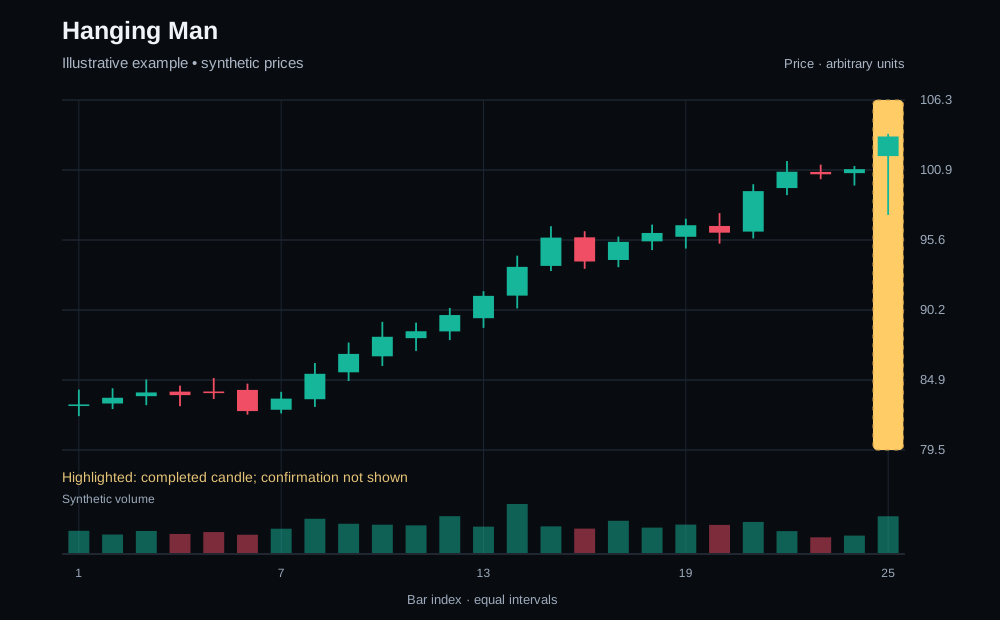
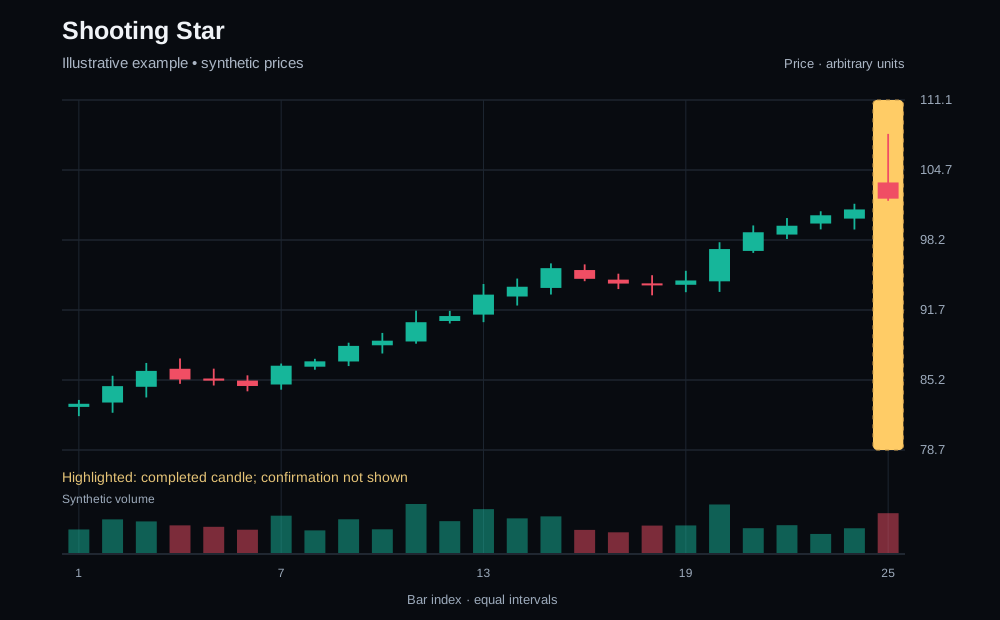
How to recognize the structure
Check the prior advance before naming the candle. Compare body and shadows; body color alone does not determine the pattern. A long shadow is not evidence of the identities or intentions of market participants.
What the observation means
These candles are possible bearish reversal observations. A later close below the candle low supplies additional downside evidence, but that follow-up was not known when the original candle closed.
Separate what was visible at the candle close from what happened afterward. A completed formation describes past price action; later candles can support or contradict the initial interpretation.
When the idea fails
A move above the pattern high challenges the bearish interpretation. If price instead continues upward, do not retrospectively relabel the candle as a confirmed top.
Decide in advance what would invalidate your interpretation. Do not move a planned exit farther away just to keep a setup alive. Gaps, thin liquidity and slippage can cause an exit to fill beyond the intended level.
Volume and market context
Volume can add context, but there is no universal volume sequence that validates this pattern. Compare activity with recent candles on the same exchange and timeframe; spot and derivatives volumes are not interchangeable. Low activity, exchange-specific spikes and changing liquidity can distort comparisons.
Check nearby support and resistance and the broader trend. A cleaner-looking pattern is not a measured chance of a favorable outcome. Multiple indicators can describe the same price movement rather than provide independent evidence.
Similar candles can carry different context
Imagine a small-bodied candle with a long lower shadow after a sustained advance. That is a hanging-man candidate, not a hammer simply because the shape matches. A small body with a long upper shadow at the same location is a shooting-star candidate instead.
The first candle’s close is the earliest point at which its final shape is known. A subsequent decline below its low may add bearish evidence, while a move above its high challenges the reversal idea. Showing both candles on a finished chart must not disguise that the second candle was unknown when the first appeared.
This is a hypothetical reading exercise, not a historical market example or trading result.
Before considering a trade
- Confirm the pair, exchange, timeframe and candle timing on your own chart.
- Compare the current price with the original formation; a move may already have extended or failed.
- Plan an invalidation level and position size using the loss you can tolerate, including fees and slippage.
- Treat measured moves and nearby levels as scenarios, not promised targets. A recognizable pattern is not by itself a complete entry, stop and target plan.
This guide explains chart-reading conventions, not an investment recommendation. Define your own decision rules before risking capital; a chart illustration does not establish a trading edge.
Related guides
For automatic monitoring, ChartScanner can detect supported patterns and send findings to Telegram.